In this post (after many months of silence... sigh) I'll be talking about a real story that happened in Sicily many years after I left. And unfortunately, I came to find out about it after casually watching a movie. At first, I didn't realized that this story was based on real events, and also that this movie made me realize how much I didn't know about Sicily since I left it.
In this movie (The Sicilian Girl - La siciliana ribelle) is depicted the true story of a Sicilian girl who lived her very short life in a very close family/mafia environment.
The name of that young girl was Rita Atria
Rita Adria lived in a famiglia intisa (well respected family) in Partanna a small town in the province of Trapani. At the age of eleven years old her father - don Vito Adria known as the, "paciere" (pacifier) a man from the old Mafia style - was killed by the men of rival Mafia gangs, because of a regional power struggles occurring in between the 1987 and 1991 (a Mafia war for the Mafioso dominion of the Belice valley which left dead on those streets dozens of people).
The Belice valley
Don Vito got killed two days after the wedding of his only son Nicola with a woman by the name of Piera Aiello. Nicola (a Mafioso himself) after the violent death of his father (don Vito) decides to take revenge on his father's killers, but six years later on June 24, 1991 he too got killed by two men that entered his home with a double barrelled, sawn-off shotgun (the Sicilian classic Lupara).
He dies not before her sister Rita, collects the most intimate confidenze on the transactions and dynamics of the Partanna's Mafia clans on her personal diaries. Her sister-in-law (Piera Aiello) after the death of her husband Nicole came with the decision to collaborate with the Italian justice and her deposition caused the arrest of many Partanna's Mafiosi. She can't longer tolerate, "i silenzi omertosi" - (is an Italian term for the Mafia’s code of silence) of an entire town and then she too became like her sister-in-law a, "testimone di giustizzia" - (witness of justice).
I like to stress that Rita Adria like her sister-in-law Piera weren't, "pentite di mafia" because they have not committed any crime to regret. I prefer to refer to them in this post as, "testimoni di giustizia".
In fact, many people in Italy still confuse the, "testimoni di giustizzia" - (witnesses of justice) with the, "pentiti di Mafia" - (informants of Mafia): The, "testimoni di giustizzia" are people who have never committed any crime and that decide to spontaneously collaborate with the Italian justice system. In the other hand the, "pentiti di Mafia" are former Mafia clan's members who have committed crimes of any sort that at some point decided to turn against their criminal organization for various reasons.
The Sicilian Girl - La Siciliana Ribelle
A picciridda (the little one - that's was the way don Vito Atria was used to call his little daughter Rita) at the age of seventeen she decides too, to take revenge for the deaths of her father and brother by talking to the Italian magistrates the same way her sister-in-law Piera did. On November 5, 1991 she got out from her home to go to the school... instead, she went straight to the office of Paolo Borsellino, (back then procurator of Marsala) to turn over to Borsellino her testimony and precious diaries in order to denounce many local mafiosi.
Of course (like her sister-in-law's decision), after her move many more ended up in handcuffs. Now everyone in Rita's town hates her too, even her own mother doesn't want to know about a daughter that speaks with the sbirri (minions of the Italian state - italian cops), anymore. Meanwhile Borsellino worried for the fate of the, "picciridda" tells her to take an Italian map and cut the Sicilian island out of the map and throw it away for good, "you must forget Sicily!". Afterward, he puts Adria under a witness protection program and moved her to a new secret location in Rome.
One thing for sure, slowly during the all of Rita's hard deal, her obsession of revenge for her loved ones turns into a lonely quest for justice.
The Mafia it's us, with our wrong ways to think and behave
During the last months she lived in Rome the only figure she could really count on was the judge Paolo Borsellino. Indeed, she saw in him a sort of protective father figure. In her diaries she wrote a lot about him. Even the Sicilian judge considered her more like a daughter than a witness, especially, because he had already a real daughter the same age as Adria.
In 1992, Borsellino was killed by a car bomb in Via D'Amelio, Palermo, less than two months after the death of his good friend Giovanni Falcone.
Paolo Borsellino
Rita learns the bad news from the television. And now, without the fatherly figure of a Borsellino ready to shield her from anyone and everyone, for sure she must have felt like the only world she has ever known was gradually shattering into very small pieces under her own feet.
A week later (it's the 26 July, 1992) after the Mafia's massacre of Via d' Amelio, in an apartment of Rome probably alone and in a mental fragility, Rita approaches a window and jumps it. Her poor body will be found on the pavement under that window of the penultimate floor in via D'Amelio. She was only 17 years old.
Rita Atria (Partanna, 4 September 1974 – Rome, 26 July 1992)
Some time after the funeral, Rita's mother went to the cemetery with an hammer in her hand to break her daughter burial stone without mercy. That's the real Mafia! A lethal cancer capable to destroy even special rapports between mothers and daughters.
Palermo's freeway after a major bomb attack from the Mafia.
In fact, in the following months more notable Italian figures were murdered in Palermo. The Mafia was, indeed, challenging the Italian State with its vicious war. Again and again, the Mafia kept murdering the servants of the Italian State sent in Sicily to fight the Mafia, and to many Italian citizens it looked as a losing war. As the months went by I felt really afraid for the Sicilians as the the Mafia had once again killed an other great Sicilian man. This time the man to be murdered was Giovanni Falcone.
Giovanni Falcone (May 18, 1939 – May 23, 1992) was an Italian magistrate who specialized in prosecuting the Sicilian Cosa Nostra. He was killed by the Mafia, together with his wife and three of his bodyguards, by a 350 kg dynamite explosion placed beneath the freeway from Palermo Airport to Palermo near the town of Capaci.
Palermo's highway after the bomb attack to the Sicilian magistrate Giovanni Falcon.
At this news, I cried. I wanted to kill one by one with my bare hands those responsible for this atrocious crime (I couldn't really express my anger by just writing it here). That murder was an other brutish way from the Mafia, to eliminate a resolute man of justice.
Capaci was the small town where I was used to go in summertime for fishing, and that freeway was the same freeway I took the last time to get to the Palermo's Airport, before I embarked into a flight that was bound for New York.
Now, my desolation was complete.
The mattanza keeps going on.
After two only months from the death of Giovanni Falcone, an other tragic assassination reaches me through the American's mass medias. This time, was the turn of Paolo Borsellino to be murdered by what seemed an unstoppable Mafia's arrogance.
Paolo Borsellino (January 19, 1940 - July 19, 1992) was an Italian anti-Mafia magistrate who was killed by a Mafia car bomb in Via D'Amelio, Palermo, less than two months after his friend and fellow anti-Mafia magistrate Giovanni Falcone had been killed by the Mafia. The bomb attack also claimed the lives of five policemen: Agostino Catalano, Walter Cosina, Emanuela Loi, Vincenzo Li Muli, Claudio Traina.
(Palermo)- Via D'Amelio after the bomb attack to the Sicilian magistrate Paolo Borsellino.
This new murder was extremely unpleasant and extremely serious, it added to the sum of more than a thousand of murders, the highest officials of the Italian State being murdered on the Sicilian streets in the space of few years: a mattanza! This freakish word, "mattanza" which I have learned in my youth, keeps coming back like a terrifying nightmare.
The turning point to the mattanza.
Going back in Palermo where the mattanza of highly Sicilian figures keeps going on, but slowly things starts to change even at the magistracy's level.
Thanks to the pentiti (collaborators with justice, or informants) of the Mafia that are testifying against their former associates.
Among the most famous Mafia pentiti (informants) is Tommaso Buscetta, the first important pentito (informant), who was very helpful to judge Giovanni Falcone in describing the Sicilian Mafia Commission or Cupola, the leadership of the Sicilian Mafia in the 1980s, and identifying the main operational channels that the mafia used and uses for its business.
And with Tommaso Buscetta start talking even bosses of the caliber of Francesco Marino Mannoia, Salvatore Contorno e Antonino Calderone.
La mattanza finally reaches its end.
Together with the informants' revelations and the magistrates' investigations, also all the investigative work from a police squad led by De Gennaro with their phone's interceptions, their following of suspects, and all their paperworks, finally, all these hard work starts to pay off, with a series of incriminations toward the men of the Sicilian Mafia.
All the incriminations emanated by the Italian judicial system will bring to the police blitz of San Michele (that's how it was called) with hundred of arrests in a single day. At last, the result of all these arrests will take to the maxi trial.
The Ucciardone's penitentiary.
The maxi trial with its 474 arrests accused of Mafia associations, began in Palermo in the 1986 inside a bunker next to the penitentiary institution of the Ucciardone. Among all the accused there are names such as Luciano Liggio, and Pippo Calò said to be the Mafia's cashier. The trial ended on December 16, 1987, almost two years after it commenced.
Palermo 1986 - Mafia's maxi trial video.
Red's note: Unfortunately, this video is only in Italian. I really sorry that I couldn't find an English translation of it.
The dark years of the Sicilian mattanza are finally over. Until...
Next: Facing the Mafia - Between mafia's myths and realities.


 Contact



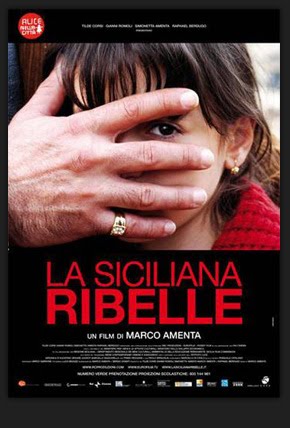 The Sicilian Girl
 The Belice valley
 Paolo Borsellino